


Renovating a Haussmannian Apartment in Paris: Timeline, Permits and What to Expect
The complete practical guide — from acquisition to final delivery
Studio de Beaulieu · March 2026
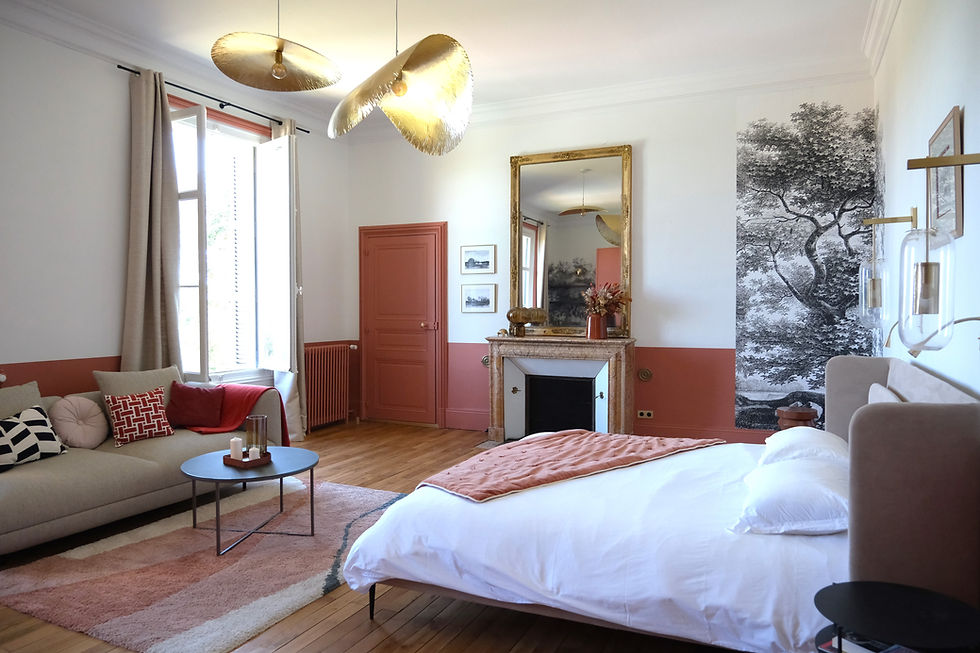
You have found it. The apartment with the ceiling height that takes your breath away, the original herringbone floors that creak in exactly the right way, the marble fireplace in the salon. The notaire has been appointed, the compromis de vente signed. Now begins the question that most buyers underestimate: how long will this actually take, what will it involve, and who do I need?
At Studio de Beaulieu, we have guided clients through this process many times — from the initial site analysis, through eighteen months of careful work, to the moment they step into a space that finally reflects who they are. Here is what the journey genuinely looks like.
Phase 1: The pre-project analysis (weeks 1 to 3)
Before any design work begins, the existing building must be understood thoroughly. For a Haussmannian apartment, this means commissioning technical diagnostics — asbestos, lead paint, structural surveys — that are legally required before any significant intervention. It also means a detailed analysis of the co-ownership regulations (règlement de copropriété), which governs what can and cannot be modified in the apartment.
In buildings near historical monuments or in protected urban zones (which covers a significant portion of central Paris), the Architectes des Bâtiments de France must be notified of any works visible from the exterior — windows, facade modifications, roof interventions. Their approval adds time to the process but is non-negotiable.
This phase also includes the first genuine conversation about the project: your programme, your priorities, your timeline and your budget. It is the foundation upon which everything else is built.
Phase 2: Design and administrative approvals (months 2 and 3)
With a clear brief established, the design phase begins. At Studio de Beaulieu, this is a collaborative process: we present spatial concepts, material proposals and mood directions, and refine them in dialogue with our clients until the vision is fully aligned.
Simultaneously, the administrative work begins. The threshold for a permis de construire (building permit) in Paris is a surface area modification of more than 40m² — most full apartment renovations fall below this threshold and require only a déclaration préalable de travaux, a simpler notification submitted to the mairie of the arrondissement. Processing time is typically one to two months.
Wall removals require a structural engineer's report confirming that the intervention is safe. In Haussmannian buildings, the walls are not always where you expect them to be, and their structural role is rarely obvious from visual inspection alone.
| Administrative approvals in Paris are not an obstacle to be avoided — they are a framework that protects the quality of what you are creating. Working within them, rather than around them, is always the right approach. |
Phase 3: Contractor selection and preparation (months 3 to 4)
The quality of a renovation is only as good as the quality of the artisans executing it. In Paris, the best contractors are sought after and often booked several months in advance. Their selection should begin well before the permits are finalised.
At Studio de Beaulieu, we work with a curated network of tradespeople — general contractors, specialist plasterers, parquet artisans, marble layers, custom joinery workshops — whose work we know and whose reliability we have verified over years of collaboration. A detailed technical dossier, prepared during the design phase, allows us to obtain like-for-like quotes and negotiate fair contracts on our clients' behalf.
For a full renovation, expect a minimum of three to four distinct trades to coordinate: structural and general works, electrical and plumbing, specialist finishes (parquet, marble, joinery), and decoration. The complexity of this coordination is, in large part, why a skilled project manager is indispensable.
Phase 4: The works (months 5 to 10, depending on scope)
A full renovation of a 150 to 200m² Haussmannian apartment typically takes eight to twelve months of active works. Smaller interventions — 80 to 100m² with partial restructuring — can be completed in four to six months. Larger or more complex projects may extend to fourteen or eighteen months.
The early weeks are the most unpredictable. Demolition reveals what was hidden behind walls, under floors and above ceilings: original structures, concealed water damage, electrical installations from five different eras. These discoveries are not exceptional — they are the norm in Parisian pre-war buildings, and they are exactly why a well-structured contingency budget (10 to 15% of total works) is essential.
Regular site visits, meticulous progress documentation and clear protocols for decision-making are what distinguish a well-managed renovation from a stressful one.
Phase 5: Finishing, furnishing and delivery (months 10 to 12)
The final phase is where the project transforms from a construction site into a home. Bespoke joinery is installed, floors are sanded and finished, lighting is calibrated, materials receive their final treatments. It is also the phase that requires the most patience — the most beautiful work is often the work that takes longest.
Furnishing and styling, if handled by Studio de Beaulieu, unfolds in parallel: furniture pieces ordered months earlier arrive, textiles are fitted, art is hung. The apartment, for the first time, breathes as a whole.
The delivery inspection — the état des lieux de fin de travaux — is the final contractual milestone, at which any remaining defects are formally documented and remedied. After this, the project belongs entirely to you.
Planning a renovation in Paris and unsure where to begin? Studio de Beaulieu offers a first confidential conversation to help you map your project. We'd love to hear about your project. Contact Studio de Beaulieu. |


Commentaires